Article
What Disqualifies You From Donating Eggs: Surrogacy and Fertility
Published

Medical, age, and lifestyle factors determine egg donor eligibility, with age windows set by each program and fertility clinic. Genetic findings, uncontrolled health issues, significant substance use, and clinic-specific BMI policies may affect eligibility, depending on the clinical assessment. Birth control use, mental-health history, and recent tattoos require individual review; timing, clinical findings, and program policy determine eligibility.
Key Takeaways
- Egg donor screening is designed to protect donor health and support informed recipient decisions.
- Birth control, mental-health history, tattoos, and prior pregnancies require individual review rather than assumptions.
- A concern does not always mean automatic disqualification; only individual screening can establish eligibility.
- Babytree Surrogacy offers complimentary consultations to discuss your individual eligibility and answer disqualification concerns.
What Actually Disqualifies You From Donating Eggs?
Egg donor eligibility is determined by a program’s screening criteria and a clinician’s review of age, ovarian health, medical and family history, infectious-disease testing, medications, and other relevant factors. Age ranges and BMI policies differ by program. A current infection or medication may require treatment, a pause, or individual review rather than an automatic, permanent rejection.
FDA requirements address communicable-disease donor eligibility, while ASRM guidance and clinic policies address additional medical, genetic, and psychosocial screening. These are different types of rules and recommendations; screening supports informed decisions but cannot guarantee a healthy pregnancy.
Why does age matter so much for egg donation?
Age reflects egg quality and ovarian response to fertility medication, both central to a successful donation cycle. Falling outside the accepted window is one of the clearest egg donor age limit rules programs apply, with little flexibility.
Does BMI really affect eligibility?
BMI may be part of a clinic’s safety assessment, but no single cutoff applies to every donor program. A clinician should consider overall health, anesthesia and retrieval risks, and the clinic’s written policy rather than treating one number as an automatic verdict.
Meeting egg donation requirements takes more than passing a lab test. Babytree helps coordinate the screening process, while the treating fertility clinic determines medical eligibility and qualified professionals address any applicable legal requirements.
What Are the Egg Donor Medical Screening Requirements?
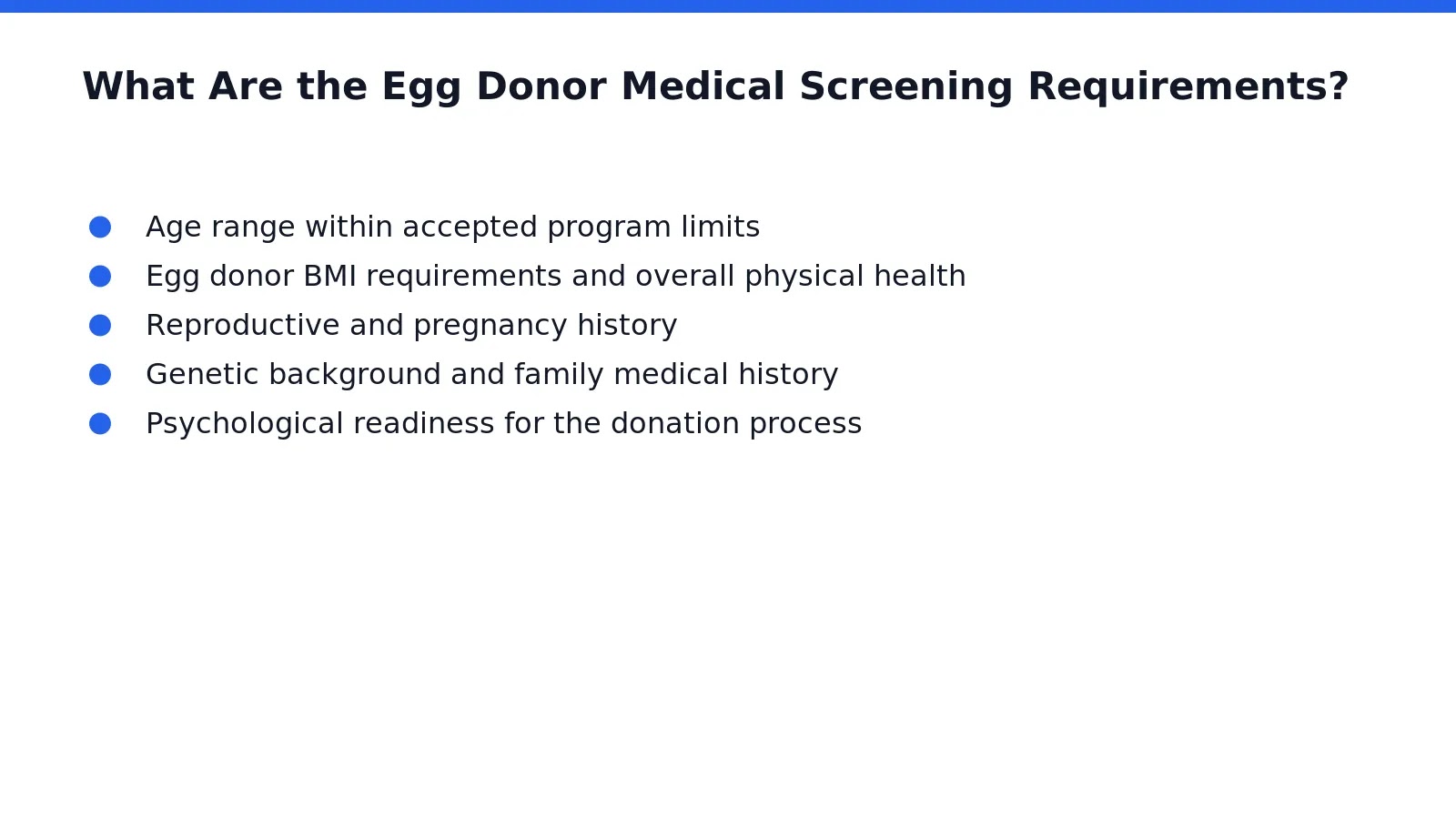
Egg donor medical screening covers age, physical health, genetic background, and reproductive history before any candidate moves forward. Egg donation requirements exist to protect donor health and give intended parents the strongest chance at a successful outcome. Age sits at the center of eligibility: most programs set a standard egg donor age limit, and candidates outside that window fall outside the applicant pool before the medical review even starts.
Babytree Surrogacy provides professional surrogacy support throughout California, covering cities including Victorville, San Bernardino, Rialto, Ontario, Modesto, and Los Angeles. Each candidate moves through genetic, psychological, and medical pre-screening before ever being matched with intended parents. The process reviews several factors together, not in isolation:
- Age range within accepted program limits
- Egg donor BMI requirements and overall physical health
- Reproductive and pregnancy history
- Genetic background and family medical history
- Psychological readiness for the donation process
This layered review supports Babytree’s Egg Donor Program in connecting intended parents with screened donors for IVF embryos, while keeping the donor biologically separate from any surrogate carrying the pregnancy.
What happens during an individual eligibility review?
A fertility team reviews health and family history, ovarian reserve, infectious-disease and genetic screening, medications, and psychological readiness together. The team can explain whether a finding rules out donation, can be addressed before reapplying, or needs further testing. For a step-by-step overview beyond screening, see Babytree’s guide to the egg donation process.
Which Factors Rule Out Donation, and Which Need Individual Review?
Some findings can rule out a candidate under a particular program’s safety criteria; others call for treatment, more information, or a later application. A clinic may defer a cycle for an active infection, review a medication with the prescribing clinician, or investigate a family-history or ovarian-reserve finding before deciding. Age limits, BMI ranges, and genetic-screening policies are not interchangeable across programs. Ask for the specific reason for any decision and whether reevaluation is possible. This article is general information; a fertility specialist makes the medical determination.

How Can Babytree Support Your Egg Donation Journey?
Babytree Surrogacy guides prospective donors through egg donation requirements with structured, transparent support at every stage. A complimentary consultation opens the process, giving applicants a chance to ask questions about eligibility before submitting any formal application. That first conversation covers everything from medical history to lifestyle factors, without pressure or cost.
Before screening begins, applicants should receive a written explanation of the process, any expenses they may be responsible for, and when decisions about eligibility will be made. Program-specific payment terms should be confirmed with Babytree rather than assumed from its surrogacy fee policy.
Does Babytree Offer In-Person Support During Screening?
Yes. Babytree Surrogacy maintains fully staffed offices across California, giving applicants access to local, in-person guidance throughout the screening process. This on-the-ground presence helps donors feel supported rather than navigating egg donor disqualifiers and paperwork alone.
Is Babytree Experienced With Egg Donor Matching?
Babytree Surrogacy has helped hundreds of families achieve parenthood through gestational surrogacy and egg donation. That track record reflects a screening and matching process built on consistency and care.
Support includes:
- A free initial consultation before applying
- Written explanation of screening and any applicable costs
- California-based offices for in-person guidance
- An established history of successful matches
FAQ
Does birth control use disqualify you from donating eggs?
Not necessarily. Birth control, a mental-health history, and tattoo timing are reviewed in context. Ask the screening team what documentation or waiting period its program requires.
Which medications disqualify egg donors?
Medication eligibility depends on the drug, dose, timing, and the donor’s health. Disclose all prescriptions and supplements to the screening clinician; do not stop medication without medical advice.
Do active infections disqualify egg donors?
An active infection may delay or prevent a donation cycle under applicable screening rules. The clinic will determine whether treatment and retesting are possible; age and BMI criteria are program-specific.
Can You Donate Eggs with PCOS?
PCOS does not produce one universal yes-or-no answer. A fertility clinician needs to evaluate ovarian response, overall health, and the safety of stimulation and retrieval under the program’s criteria. Disclose a PCOS diagnosis during screening rather than assuming eligibility or ineligibility.
Conclusion
Understanding egg donation disqualifications empowers you to make informed decisions about your reproductive health and family-building journey. While medical, genetic, and lifestyle factors shape eligibility, some findings can be addressed or reevaluated; others may prevent donation under a program’s criteria. If you’re considering egg donation, a comprehensive medical evaluation with a qualified fertility specialist provides clarity on your individual candidacy. Approach this decision with confidence, knowing that thorough screening protects both your wellbeing and the intended parents’ hopes for a healthy pregnancy.
Ready to start your journey?
Whether you're building your family or ready to help one grow, the first conversation is free.